Homeschooling in Thailand
A balanced look at homeschooling and international schooling for expat families in Thailand — the different models, what regulation and university pathways mean in practice, the real cost of parent time, and how to decide which route suits your family.

Quick answer
Homeschooling in Thailand for expat families: legal registration, curriculum options, costs, exams and how homeschooling compares to international school.
At a glance
- Country: Thailand
- Sections: 11
- Questions answered: 10
- Schools listed: 7
- Read time: 13 min read
Why expat families in Thailand consider homeschooling
Homeschooling is a live option for a meaningful minority of expat families in Thailand, and the reasons are rarely ideological. Cost is one: international school fees in Thailand are a significant household expense, and families on a single income, a long-term but modest budget, or a posting without a school allowance sometimes look at homeschooling as a way of making the numbers work, at least for a period.
Location is another. Not every part of Thailand has a nearby international school, and for families based well outside Bangkok, Chiang Mai, Phuket, Pattaya, Hua Hin or Samui, the nearest suitable school may involve a long commute or a boarding decision they are not ready to make. Families on short postings sometimes conclude that enrolling a child for two terms and then withdrawing them causes more disruption than it solves. Families who travel for work, or who want to travel as a family for an extended period, often find a portable education model fits their life better than a fixed term-time school.
A smaller but important group turns to homeschooling because school has not worked well for their child — a difficult year, a mismatch with a particular environment, or a child who needs a slower or more individual pace than a class of twenty or more can offer. Others have a child with specific learning needs that a local school cannot yet meet, or a child on an elite sport or performing-arts pathway whose training or touring schedule simply does not fit a conventional timetable. None of these are unusual reasons, and none require families to feel they are doing something eccentric — but each comes with real trade-offs, which is what the rest of this guide sets out honestly.
The main homeschooling models
Parent-led homeschooling is the most flexible and the most demanding model. A parent (or a shared arrangement between parents) designs and delivers the curriculum, sets the pace, and takes full responsibility for progress. It suits families with the time, confidence and often the professional background to plan a coherent education across several subjects and several years, and it allows genuine responsiveness to a child's interests and pace. Its risks are equally real: gaps can appear in a subject a parent finds less comfortable to teach, motivation can dip without the structure of a class, and sustaining it well through the secondary years, when subject content becomes more specialised, is harder than most families expect at the outset.
Accredited online or distance schools sit at the other end of the spectrum. A recognised provider sets the curriculum, provides teachers, marks work and issues progress reports, and the parent's role shifts from teaching to supporting and supervising. This model gives a clearer, more portable qualification pathway and takes pressure off parents to design the curriculum themselves, but it is not free of parent input — younger children in particular still need a present adult to keep a school day structured — and quality varies a great deal between providers, so due diligence matters.
Tutor-supported hybrids blend the two: a parent oversees the overall programme while paid tutors, often local or online, teach specific subjects, especially ones like mathematics or a foreign language where specialist teaching helps. This spreads the teaching load and can plug gaps in parental subject knowledge, at the cost of coordinating several people and, usually, a higher bill than pure parent-led education.
Small learning pods — a handful of families combining resources to share a tutor or a small teaching space — have become more common among expat communities in Thailand. Pods can solve the socialisation gap that worries many families and share the cost and planning burden, but they depend entirely on finding compatible families with children of a similar stage, and they can be fragile if one family leaves the group.
The regulatory picture: what you need to check, not what this guide can tell you
Home education in Thailand sits within a regulatory framework that governs Thai citizens and, separately, within the visa and residency framework that governs foreign nationals living in the country. Both of these areas are genuinely complex, they change over time, and how they apply can depend on your nationality, your visa category, and the specific arrangement you have in mind. This guide cannot and does not set out those rules.
What matters practically is this: if you are considering home education in Thailand, you should check the current official position directly with the relevant Thai authorities and, separately, confirm how your visa and residency status is affected, ideally with a qualified immigration adviser or education consultant who works specifically with expat families. Do this before you commit to a plan, not after, because unwinding an arrangement that turns out not to be compliant is far harder than checking first. Nothing in this guide should be treated as legal or regulatory advice, and rules described anywhere else online, including in expat forums, may be out of date or specific to a situation that does not match yours.
Qualifications and university pathways
In principle, a child can reach recognised school-leaving qualifications — IGCSEs, A-levels, an American high school diploma, or Advanced Placement courses — through an accredited online or distance school, sitting exams either through the provider's own arrangements or at a registered exam centre. Several international schools and dedicated exam centres in Thailand offer private candidate exam sittings, which is how many homeschooled students complete formal qualifications without being enrolled full-time.
The detail that catches families out is accreditation and exam-centre access. Not every online provider is recognised in the way a family assumes, not every exam board qualification is accepted identically by every university system, and exam-centre capacity for private candidates is limited and must be arranged well in advance — sometimes a year or more ahead for popular subjects and sitting windows. Before committing a family to a particular online school or qualification pathway, check directly with the provider what accreditation it holds, confirm with prospective universities in the country you expect your child to apply to that the qualification is accepted, and confirm with a specific exam centre that it will take your child as a private candidate for the subjects and sittings you need. None of this should be assumed from marketing material alone.
Socialisation and community: a realistic view
Socialisation is the concern raised most often about homeschooling, and it deserves a realistic answer rather than a dismissive or an alarmist one. A school provides a built-in daily peer group, structured group activities, and a wide social mix, all without any extra planning by parents. Homeschooling provides none of that automatically — every social opportunity has to be actively created, whether through sport clubs, activity classes, expat community groups, religious or cultural organisations, or a learning pod.
Many expat communities in Thailand have an active homeschooling network, and families who invest time in finding it often build a rich and varied social life for their children, sometimes more varied in age range than a single school class would offer. The families who struggle are usually those who assume socialisation will happen by itself, or who move somewhere without first checking whether a homeschooling community exists locally. If you are seriously considering this route, look into the local community before you commit, not after.
Not sure which schools fit your family?
Choosing an international school depends on your child's age, curriculum preference, location and budget. Tell us what you're looking for and we'll help you identify schools worth considering.
Cost, in structural terms
It is tempting to assume homeschooling is simply cheaper than an international school, and in cash terms it very often is — there is no comparison to the fee structures set out in our guide to school fees in Thailand, which is worth reading alongside this one. But the comparison is not as clean as it first looks. Accredited online schools, quality tutoring, exam-centre fees for private candidates, curriculum materials and, for hybrid and pod models, shared staffing costs all add up, and a well-resourced homeschooling setup for an older child sitting formal exams can become a substantial expense in its own right.
The honest way to compare is structural rather than numerical: an international school fee is a single, predictable, all-in figure that buys teaching, facilities, activities and pastoral support in one package. Homeschooling costs are spread across several smaller decisions — a curriculum subscription here, a tutor there, an exam entry fee elsewhere — and the total depends heavily on how much of the model a family delivers itself versus buys in.
The parent-time cost: the most underestimated factor
Ask any family that has homeschooled for more than a year what they underestimated beforehand, and the answer is almost always time — specifically, one parent's time, and specifically how much of it disappears into planning, teaching, marking, researching curricula, managing a child's motivation on a hard day, and organising the social and enrichment activities a school would otherwise provide as standard.
This has real consequences for a family's wider life in Thailand. It usually rules out, or sharply limits, that parent's own work or career plans for the period in question. It changes the shape of the working day for the whole household. And it does not shrink neatly as a child gets older — secondary-level content generally demands more specialist input, not less, even where a child has become a more independent learner. Any family weighing homeschooling against a school should cost this time honestly, in the same way they would cost school fees, before deciding it is the more affordable option.
English and Thai language considerations
For English-speaking families, most homeschooling routes run entirely in English, which removes one of the practical hurdles that international schools sometimes present for children still building English proficiency. That is a genuine advantage for some families in the early stages of relocation.
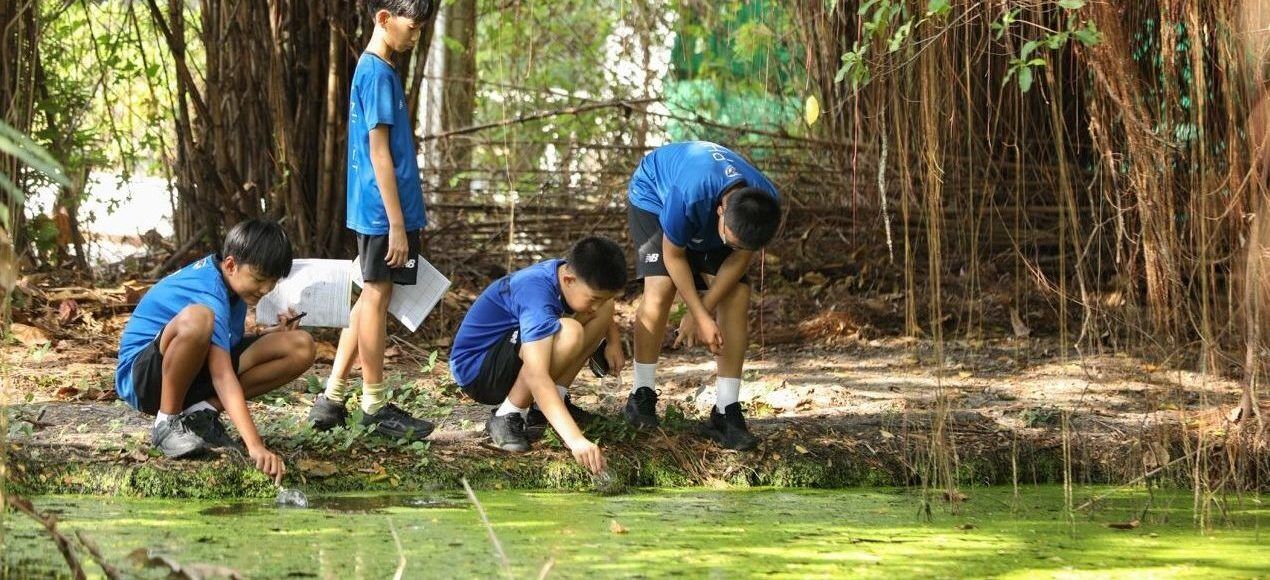
The trade-off is that a homeschooled child living in Thailand may get less structured exposure to spoken Thai than a peer attending a local or bilingual programme, unless the family actively builds Thai language and cultural contact into daily life — through tutors, community activities, or simply daily life outside an English-speaking bubble. Families who value their children building genuine local language and friendships sometimes find a school environment does more of this work for them by default, while homeschooling families need to be more deliberate about it.
Combining approaches and switching between them
Few families in Thailand pick one model and stay with it unchanged for years. It is common to homeschool through the early years when the curriculum is simpler and flexibility matters most, move to a hybrid or pod arrangement as subjects specialise, and then move into a school for the final years of secondary when exam-board access, laboratory facilities, or the social pull of a larger cohort become more important. Others do the reverse: they start their child in school, find it is not working for a period, and step back into homeschooling for a term or a year before returning.
Switching direction is entirely normal and not a sign of failure in either direction. What matters is planning the switch deliberately rather than reactively wherever possible, particularly around exam timing, so a change of approach does not collide with a set of assessments a child has already started.
A decision framework: who does each option suit?
Parent-led homeschooling tends to suit families where one parent has the time, temperament and confidence to plan and deliver a broad curriculum, where the children are younger, and where the family values flexibility above a fixed structure. It is a harder sustained fit for families needing two incomes, or for secondary-age children heading towards specific, exam-board qualifications.
An accredited online school tends to suit families who want the flexibility of learning from anywhere but prefer a set curriculum and outside teaching, and who are prepared to research providers carefully and confirm exam-centre access well ahead of time. A tutor-supported hybrid suits families who want to stay closely involved but know their own limits in one or two subjects. A learning pod suits families who have, or can build, a genuine local community of compatible families, and who see socialisation as the single biggest risk to manage.
An international school remains the more straightforward choice for most families who want a predictable structure, an established peer group, on-site facilities and pastoral support, and less day-to-day demand on a parent's own time — provided the cost fits the household budget and a suitable school exists within reasonable reach.
Re-entry into school: how it actually works
Moving a homeschooled child into an international school is common in Thailand and schools generally have a process for it, but the process is an assessment, not an automatic transfer. Expect the school to ask for evidence of the work your child has done — records, a portfolio, results from any formal assessments or exams sat — and to run its own placement assessment, in the same way it would for any new applicant described in our guide to how to apply.
Year-group placement is decided on the school's judgement of the child's level, not simply their age, and it is worth being open to the possibility that a school places a child a year above or below the age-typical group if that is where it believes the child will do best. Building a simple ongoing record of your child's work, wherever your homeschooling journey is heading, makes this transition considerably smoother if or when it happens — most admissions teams say this is the single most useful thing a homeschooling family can bring to a re-entry conversation.
Frequently Asked Questions
Is homeschooling legal for expat families in Thailand?
Homeschooling in Thailand sits within a regulatory framework that can depend on nationality, visa status and the specific arrangement involved, and the rules can change. This guide cannot set out current legal requirements — check directly with the relevant Thai authorities and take specialist immigration and education advice before committing to a plan.
Can a homeschooled child get into a good university from Thailand?
In principle, yes, via recognised qualifications such as IGCSEs, A-levels, an American high school diploma or Advanced Placement courses, sat through an accredited online provider or a registered exam centre. Confirm the provider's accreditation and check exam-centre access well in advance, since capacity for private candidates is limited.
Is it cheaper to homeschool than pay international school fees in Thailand?
Often cheaper in cash terms, but the comparison is not clean — online curricula, tutoring and exam fees add up, and the biggest hidden cost is parent time. See our school fees guide for the structure of international school costs.
How do I make sure my homeschooled child gets enough socialisation in Thailand?
Look into the local homeschooling community before you commit — clubs, activity classes and learning pods exist in several expat hubs, but none of it happens automatically, so it needs deliberate planning.
What is a learning pod and is it common in Thailand?
A small group of families combining resources to share a tutor or teaching space. It is increasingly seen among expat communities in Thailand, and it helps address socialisation, but it depends on finding compatible families locally.
Can I switch my child from homeschooling into an international school later?
Yes, this is common. Schools generally run their own placement assessment and ask for evidence of previous work; year-group placement is based on the school's judgement of level, not simply age.
Do online schools work well for younger children in Thailand?
They can, but younger children generally still need an adult present to keep the school day structured, even with an accredited provider delivering the curriculum and marking work.
Will homeschooling affect my visa or my child's status in Thailand?
It can, depending on nationality and visa category, and the rules change. Confirm your specific situation with a qualified immigration adviser before making any decisions about schooling.
How much of my time will homeschooling actually take?
More than most families expect, and it does not reduce as children move into secondary-level content, which typically needs more specialist input, not less. Cost this time honestly before comparing it to school fees.
What Thai language exposure will my child get if I homeschool?
Less than a peer in a local or bilingual programme by default, unless you actively build Thai language and cultural contact into daily life through tutors or community activities.
International schools in Bangkok
International schools in Chiang Mai
International schools in Phuket
Get matched with the best school in Thailand
Tell us what you're looking for and we'll recommend the international schools that genuinely fit your family.